Flagship case study
Groundwork
Maturity ledger
Groundwork's capabilities sit in three states: 10 built and running in production, 11 confirmed and locked in specification, 6 provisional at vision scope. Everything below this ledger shows production capability only.
Built in production
- Marketing production system
- Brand systems and templates
- Events and campaigns
- Briefs and channel copy
- Editorial versioning and approval
- Email sequences
- Quick Create and Design Studio
- Handshake CSV import foundation
- Public event sharing
- Soft delete and restore
Confirmed and locked
- Home and personal workflow
- Inbox and capture fan‑out
- My work
- Weekly update and team digest
- Advisor design approval
- Student email templates
- Workshop Studio
- Training and SCORM analysis
- Committees
- Reconciliation and coverage
- Access console and audit log
Provisional at vision scope
- Partner records
- Funding cycle details
- Deployment queue
- Knowledge library
- Workflow builder
- Semester report assembly
The live product
The running build, embedded. Click into it.
Problem
A 20‑person center runs more than 100 events a semester. Each one needs a campaign brief, event copy, a promotional email sequence and finished designs. Before Groundwork, every asset was produced by hand. When an event detail changed, someone had to remember every asset that had already gone out carrying the old version.
What it does
One structured event entry produces the campaign brief, on‑brand copy, a timed three‑email sequence and finished designs. Change any detail on the event and every asset derived from it is marked out of date by name.
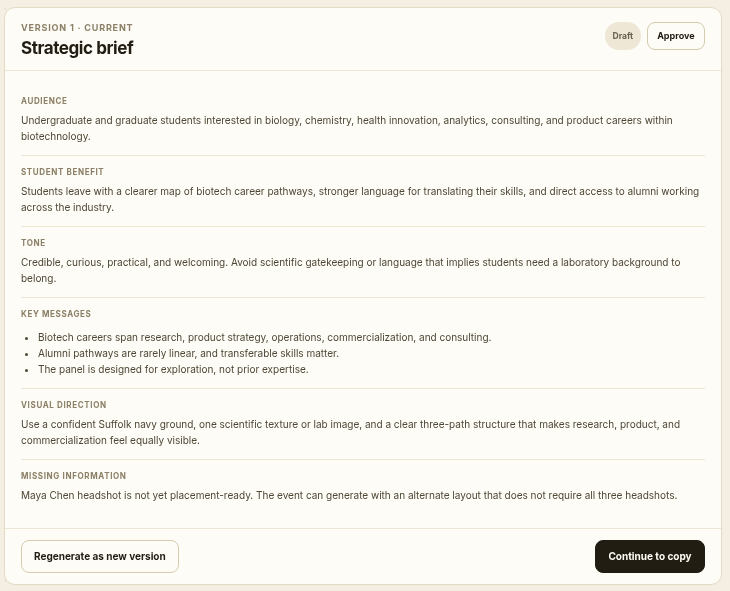
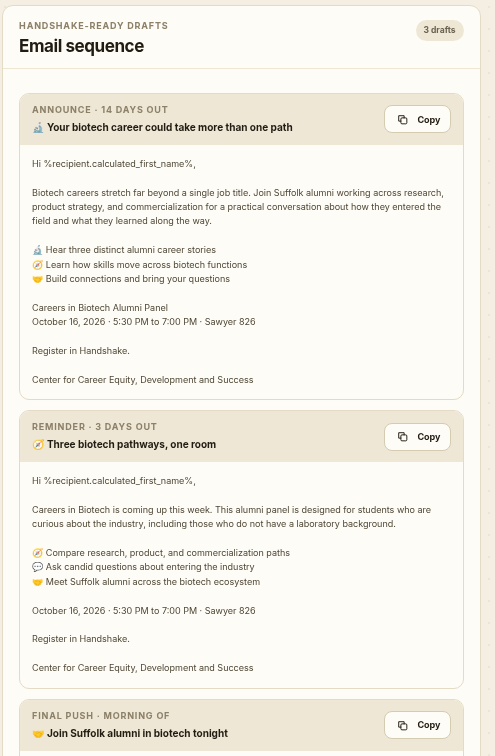

Production capabilities only.
Architecture
01 / Humans publish
Every external output ends in a copy action, a download or a share link. Workflows can draft and they can flag. They cannot send, post or publish.
02 / No student identity
Advisor captures are private to the advisor. Shared destinations are locked. Counts are aggregate. Funding records carry anonymized identifiers, and the identity key is held outside the system.
03 / Fixed rendering
The design engine holds 11 layout templates, rendered light and dark. The model selects among them; it cannot write arbitrary CSS. Preview and export walk the same render tree, so what a reviewer approves is what ships.
04 / Provenance is labeled
Verified, approved and synthesized content carries distinct labels. Missing data is shown as missing.
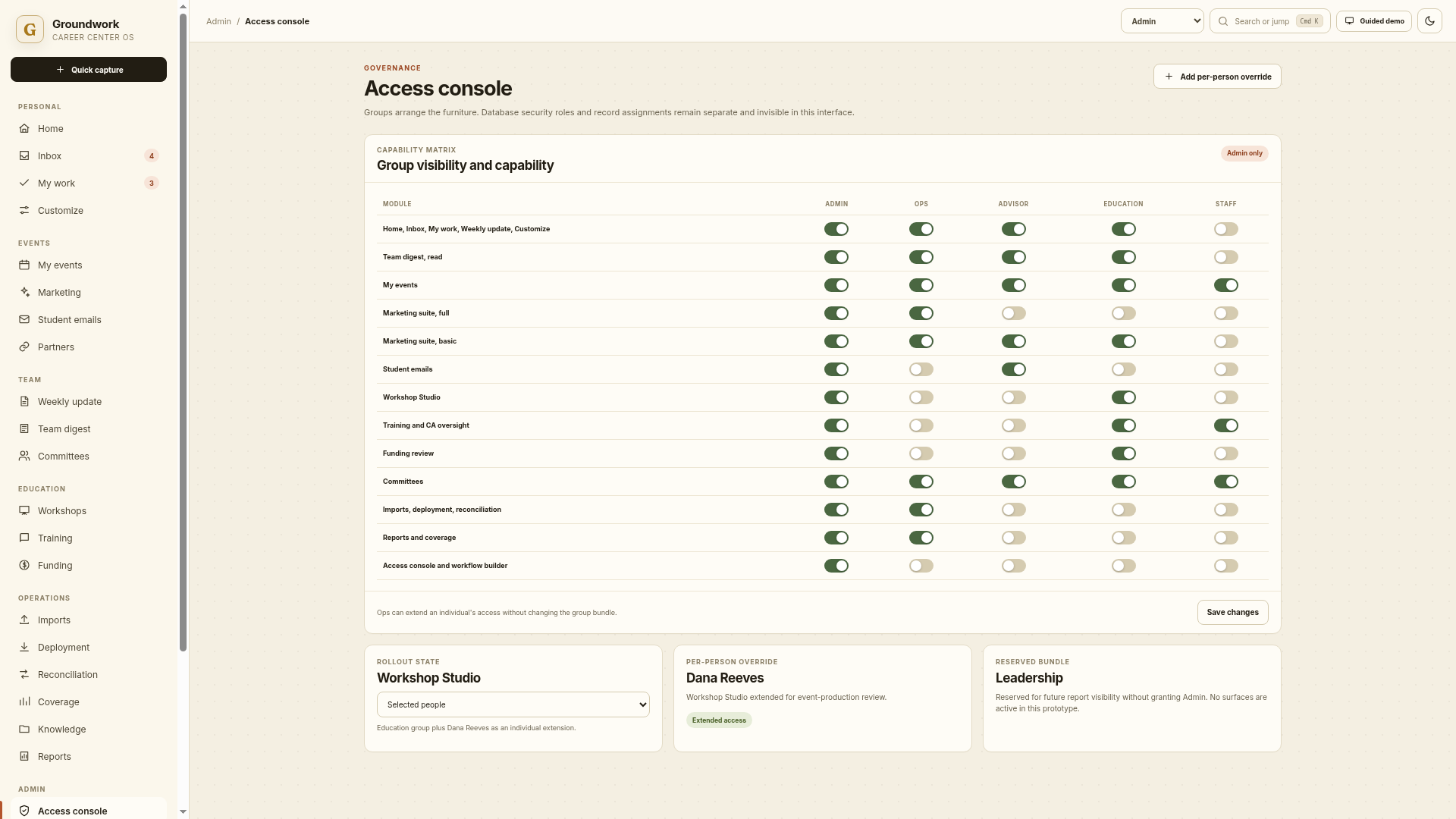
Access control
Role permissions are enforced in the database, not in the interface, and verified by adversarial testing against each role.
Editorial layer. Generated content passes a human approval step before it becomes an asset. The generation‑governance layer itself sits in the locked specification above.
Build log
32 scoped production releases prototyped.
What this does not show yet
An adoption pilot is scoped. Usage data will be added when the pilot produces it.